Not Guilty Does Not Mean Innocent: Inside the Tori Tropf and Roger Reiley Trial
How a loophole in Idaho Animal Cruelty Statute shaped the outcome.
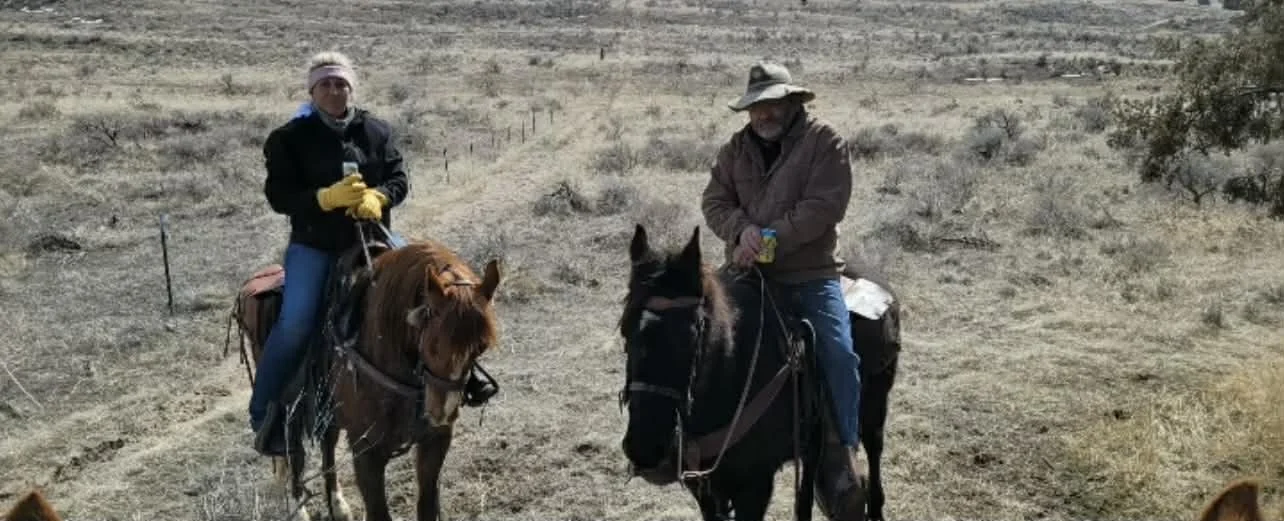
Tori Tropf and Roger Reiley of Teton County, Idaho
⚠️ Important Notice-The following post contains disturbing details of animal abuse. Please proceed with care.
The facts, opinions, and evidence in this article are direct observations of the author and any conclusions drawn from the facts and evidence are solely the opinion of the author.
I directly observed all three days of trial proceedings in the courtroom and reviewed public records, affidavits, and trial exhibits for this account.
TETON COUNTY, ID. — On October 6, 2024, a horse that had been purchased from Roger Reiley and Tori Tropf earlier that year was returned to them by its owner for a behavioral “tune-up.” The owner testified to trusting the trainers but reported issues during trail rides, such as the horse kicking and resisting. The events that unfolded after the horse's return, some of which were captured on video, later became pivotal evidence in a criminal case.
The video shows the horse restrained in front of a structure identified in court as “The Shack.” The animal’s head is secured on both sides to a post on the left, chains on the wall to the right, and a loop embedded in the concrete floor. Canvas with cans is attached to the horse’s face. A rope is placed around the horse’s neck and then looped around the left hind leg, which is drawn upward toward the horse’s belly and tied to a post behind the horse. When the horse attempts to extend or kick with the restrained leg, this configuration pulls the horse’s head downward, further restricting movement. At one point, Tropf is observed applying her full weight to the horse’s head while Reiley tightens the rope from the ring under its chin to the loop in the concrete. While forced to balance on three legs, the horse is struck repeatedly—over sixty times—with whips and 4-inch PVC pipes, falls to the ground, and is then kicked and whipped to make it stand. Due to the immobilization of its head, the horse, with its head suspended while lying on its left side, has the left hind leg still bound beneath it and unable to get up. Tropf and Reiley continue to whip and kick the horse in the face. This sequence happened multiple times. Tropf yells at Reiley, “We can’t kill him, he is not ours. Based on the condition of anonymity, we were told Tropf and Reiley call this “stretching them out”.
October 6, 2024 The begining of the video that lead to cruelty charges against Tori Tropf and Roger Reiley.
October 6, 2024 - The video that lead to animal cruelty charges.
Additional Allegations Shared on Condition of Anonymity
Several individuals, who requested anonymity and whose accounts have not been independently verified, have shared further troubling allegations regarding Tropf and Reiley’s treatment of horses. According to these sources, it has been alleged that Tropf and Reiley have drowned horses, tied horses up for days with their legs bound in unusual configurations, beaten horses with farrier tools, overworked horses until they could not stand, and, when horses were unwilling to cross water, held their heads underwater until they stopped struggling. These accounts remain unvetted and are included here for transparency regarding information circulating in the community. Readers should consider the anonymous and unverified nature of these allegations.
From Video to Arrest
After the events of October 6, 2024, the video was given to law enforcement that same day.
Two days later, on October 8, 2024, Tropf and Reiley were arrested and faced charges under Idaho Code § 25-3518 (Beating and Harassing Animals) and Idaho Code § 25-3504 (Cruelty to Animals). The horse from the video was removed from the property, while the remaining animals were left on-site. Police executed a search warrant and collected several items as evidence.
On October 11, 2024, the court issued an order establishing conditions of pretrial release for the defendants. The order prohibited Tropf and Reiley from having contact with horses, mules, or donkeys, barred them from consuming alcohol or illegal drugs, and required them to avoid further legal trouble. Public records also show that Roger Reiley was on probation at the time of his arrest.
Developments Before Trial
Several notable events occurred in the months before the trial, which drew the attention of close observers. On November 6, 2024, the court lifted the pretrial release conditions. This allowed Tropf and Reiley to again have personal horses in their care and to resume public training activities.

Deceased black horse being transported from Tori Tropf and Roger Reiley’s property.
On December 25, 2024, a black horse associated with Tropf and Reiley died, reportedly from colic, according to Tropf. Community members questioned the handling of the death, noting that neither a veterinary necropsy nor a formal review took place. The horse was dumped on land owned by Blaine Briggs, who would later testify as a defense expert. Although the Teton County Sheriff’s Office purportedly received the dumping location, they did not seek a warrant or conduct further investigation.
In May 2025, another horse reportedly died on the same property. No new charges were filed, and authorities did not investigate either of the deaths further.
Separately, videos dating back to 2020 and 2022 show the treatment of horses and mules that raise similar concerns.
On October 15, 2021, a palomino mare was quietly eating hay from a feeder. At around noon, it was reported that the horse became stuck in the feeder and was unable to free herself. Later that evening, Tori Tropf and Roger Reiley arrived home.
According to allegations later reported to law enforcement, Tropf and Reiley were intoxicated when they attempted to remove the mare from the feeder. During that attempt, the mare suffered a catastrophic injury, including a broken leg.
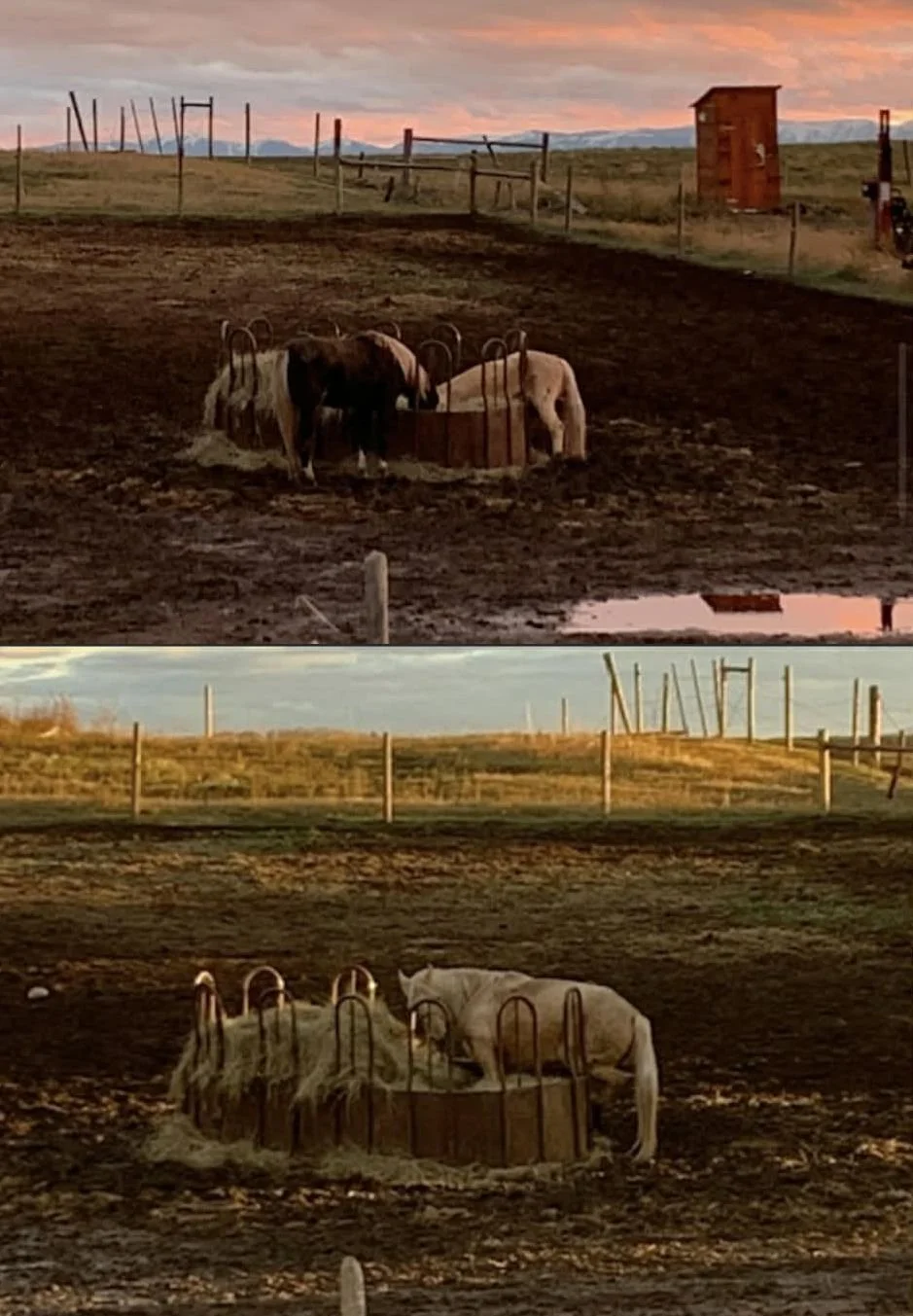
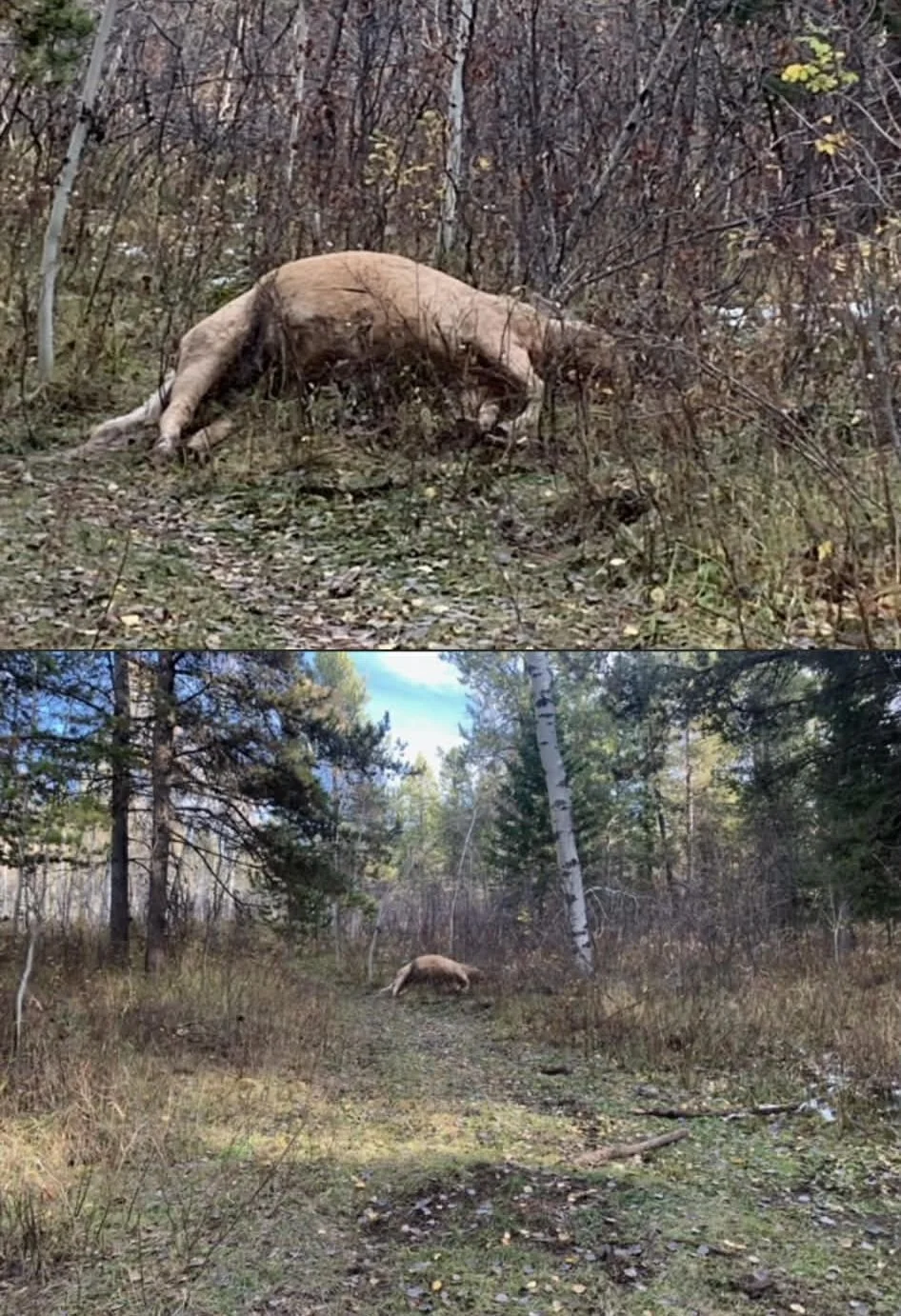
After the injury occurred, Roger Reiley shot the mare and her body was disposed of on U.S. Forest Service land.
The incident and disposal were subsequently reported to a U.S. Forest Service law enforcement officer, bringing the events to the attention of federal authorities.
While this incident was not the direct subject of the later jury trial, it is one of several reported events over the years involving horses under Tropf and Reiley’s care. Taken together, these incidents raise difficult and unresolved questions about responsibility, animal welfare, and where the boundary lies between accidental misfortune and cruelty in the handling of horses.
June 6, 2022 Tori Tropf Whipping a Mule
Part 2 of the video of Tori Tropf whipping a mule and cussing at it
The Charges and the Trial
The court moved the case from Teton County to Jefferson County, with a special prosecutor from Twin Falls County. The day before trial, on December 9, 2025, the charge on 10/06/2024 of Idaho Code § 25-3518 BEATING AND HARASSING ANIMALS was amended to Idaho Code § 25-3504, COMMITTING CRUELTY TO ANIMALS.
The jury trial began on December 10, 2025, one day after the charges were amended.
Prosecutors argued that the video demonstrated unnecessary cruelty under Idaho law, emphasizing the degree of restraint, the frequency of strikes, and the horse’s inability to escape.
The defense responded that Tropf and Reiley acted under pressure because the horse’s owner had threatened to shoot the animal. The defense characterized the training as “pressure and release” and cited statutory language exempting “normal and accepted” or “commonly used” animal husbandry practices, including those related to training animals. They claimed the methods shown in the video were common in the region and therefore lawful.
Witnesses and Testimony
State of Idaho Expert Witnesses.
The individuals (neighbors) who recorded the incident testified at trial. They explained that they were sitting down for dinner when they heard a disturbance outside and began filming after realizing something was wrong. Both testified that what they were witnessing did not sit right with them and that they felt a responsibility to document it. Their decision to record was described as an immediate, human response to concern—not a calculated act. Although the defense suggested the filming was motivated by retaliation connected to prior legal disputes between neighbors, both witnesses stated under oath that this was not their intent.
A professional horse trainer testified for the state that the video showed methods inconsistent with accepted equine training practices. The witness explained that excessive force, long restraint, and repeated striking can cause both physical and psychological harm. The witness emphasized that fear-based training is less effective and more likely to cause trauma or further behavior problems rather than improvement.
Dr. Scott Leibsle, Idaho’s State Veterinarian, testified as an expert witness for the prosecution. In his role, he oversees statewide animal health regulation, disease surveillance, and enforcement related to livestock welfare, including equines. His background includes private equine practice and regulatory veterinary medicine. This puts him at the intersection of veterinary science, animal welfare standards, and statutory enforcement.
Despite Dr. Leibsle’s qualifications, in our opinion, the prosecution did not fully flesh out Dr. Leibsle’s expertise. As a result, we believe, foundational veterinary issues remained largely unexplored. Dr. Leibsle could have provided insight into the long-term physical and psychological impacts of the training methods shown in the video. He could have explained how veterinarians assess pain, stress responses, and distress in horses. Veterinary testimony often explains clinical findings and behavioral responses that lay observers may not notice.
As the final witness, the prosecution called the only veterinarian who evaluated the horse in the video. The defense objected, arguing that the veterinarian had not been formally designated as an expert witness and vigorously opposed her testimony. Ultimately, the court allowed her to testify only in lay terms and did not accept her statements as expert opinion.
Defense Witnesses.
The defense called the horse’s owner as a witness. The owner had purchased the horse from Tropf and Reiley in early 2024 and, in his testimony, stated that he trusted them and that they were “trainers”. He also stated that he did not put a timeline on training the horse, nor did he say he would kill the horse. He did state, “he could not in good conscience sell a horse he knew kicked”. He also testified that the horse still kicked, indicating the training was ineffective and he no longer owned the horse; he “shipped it back”. However, our research could not find any public record (brand inspection) of the purchase of the horse or the sale of the horse from January 2024 to December 2025.
The second expert witness was Tropf and Reiley’s farrier, Elijah McNutt, a veteran and graduate of the Montana State Farrier School. McNutt characterized the horse as “belligerent,” “sour,” and having a “poor disposition.” He testified that the animal’s behavior reflected defiance rather than distress and described his handling philosophy as the “old school” or “cowboy way.” McNutt stated that the horse threw itself to the ground as an act of defiance and asserted that a horse exhibiting such behavior would “go to Canada and be on someone’s dinner plate.” He further testified that natural horsemanship methods would not be effective with this horse.
Blaine Briggs, who was presented as an expert witness, is a graduate of Idaho State University, a science teacher at a local high school, and a neighbor of Tropf and Reiley. During his testimony, Briggs stated that implements such as PVC pipes and wooden tools would not cause serious harm to a horse. He asserted that “the impact of striking a horse with your foot would hurt your foot more than the horse.” He characterized the horse’s reactions in the video as refusal rather than fear and argued that an “escalation of force was necessary to compel compliance.” Briggs further maintained that the conduct depicted was “an acceptable and commonly accepted standard.” He concluded his testimony by stating, “There is a reason old shovel handles aren’t junk.”
Neither the prosecution nor the defense questioned Briggs regarding the deceased horse that was disposed of on his property in December.
Defendant Testimony
Tori Tropf testified in her own defense. She described a past experience at the age of 14 years old in which she lost a horse after failing to get the animal back on its feet, calling the event traumatic. She stated that this experience influenced her actions on October 6, 2024.
During trial testimony, Tropf stated that she believed the horse shown in the October 6 video was experiencing a life-threatening emergency, a belief she said justified the force used to make the horse stand. What was interesting is that in December 2024, shortly after pretrial restrictions were lifted, Tropf’s personal horse, which was observed down in a pen with other horses during a colic episode. In that instance, the response appeared markedly different. The horse was not kicked, whipped, or struck in an effort to force it to stand. It died hours later. While this information was not part of the court record, the contrast raised questions.
Closing Arguments
In closing arguments, the prosecuting attorney told the jury, “We can prove every behavior in this video is cruelty.” The prosecution pointed to Idaho’s statutory definition of animal cruelty, arguing that the conduct shown met each element: the intentional infliction of pain through repeated striking with a four-inch PVC pipe and excessive whipping; physical suffering, evidenced by the horse crying out when kicked and struck; and injury, supported by veterinary testimony documenting a facial scrape and soreness along the horse’s back. During the video, Tropf can also be heard stating, “We’re not going to kill him, we do not own him.”
The defense attorney told the jury, “We don’t like what this looks like,” and used the definition of “common” from the statute. Stated his clients and expert witnesses consider this “common practice” pressure and relief training, and referenced that the State of Idaho doesn’t have standards for horses.
When the video was played, the courtroom was quiet. The footage began with Ms. Tropf striking the horse with a closed fist and shouting, “How do you like that you cocksucker.” Neither defendant showed visible emotion. Instead, they looked at one another and laughed. As an observer in the courtroom, I found the moment difficult to reconcile with the gravity of what was being shown.
Verdict and Outcome
The jury returned a verdict of not guilty. Why? The reduced charge from Beat and Harass to Cruelty gave access to a loophole in the definition in cruelty.
The practices, procedures and activities described in this section shall not be construed to be cruel nor shall they be defined as cruelty to animals, nor shall any person engaged in these practices, procedures or activities be charged with cruelty to animals. an exemption for “normal and accepted” husbandry practices.
The horse lost
In the end, the horse lost. The owner stated the training did not help the horse with the unwanted behaviors, and the horse was “shipped back”.
The Statutory Loophole
The prosecution based its case on expert testimony and established best practices.
We believe the statutory language, rather than the evidence presented, determined the outcome. Idaho Code § 25-3504 is the state’s general animal cruelty law, but it exempts conduct considered "commonly accepted” without specifying what those practices are for horses. For instance, practices such as branding and dehorning have long been debated, yet are considered standard for cattle. Similarly, controversial horse training techniques such as ‘soring’ in Tennessee Walking Horses or tail docking have historically faced scrutiny but have been seen as traditional in certain circles. These examples highlight the complexity of defining what is ‘commonly accepted’ in the equine world, leaving room for interpretation and often contention.
Why This Story Matters
This case underscores the disparity between legal standards, jury determinations, and the equine community’s perspectives on humane, ethical, and effective horse handling.
Where should the boundary be established when suffering is justified as training? Is there a threshold where the methods become ethically questionable? How do we balance tradition with the responsibility of ensuring animal welfare?
In light of these questions, it is essential for the equine community to take action. Equine professionals are encouraged to advocate for clearer standards and to participate in policy discussions to ensure humane training practices. Through collective responsibility and proactive engagement, the industry can advance toward a future in which tradition and animal welfare coexist harmoniously.
Sources
Idaho Statutes and Codes
Idaho Code § 25-3504 (Cruelty to Animals)
Idaho Code § 25-3507 (Beating and Harassing Animals)
Idaho Code § 25-3518, § 25-3502, § 25-3520A, § 25-3515 (Other Animal Welfare Statutes)
https://legislature.idaho.gov/statutesrules/idstat/ (Idaho Statutes)
Court Documents and Affidavits
Teton County Sheriff’s Office Affidavit (Deputy Hayes)
Court filings, charging documents (Teton County)
Expert and Witness Testimony
Testimony of a professional horse trainer
Testimony of Dr. Scott Liebsle, Idaho Department of Agriculture
Testimony of horse owner and other trial witnesses
Demographic and Regional Data
U.S. Census Bureau: Age Demographics by County (Bonneville, Teton, Fremont, Madison)
University of Idaho Extension: Regional Agriculture & Equine Programs
BYU-Idaho Extension resources
Industry Standards and Professional Guidelines
American Association of Equine Practitioners (AAEP) Guidelines: https://aaep.org/
Certified Horsemanship Association: https://cha.horse/
Low-Stress Livestock Handling Resources (e.g., Temple Grandin, Dr. Bud Williams)
University veterinary extension publications
News and Media
East Idaho News coverage of the case
Public statements and press releases
Other Materials
Video footage from October 6, 2024, and prior years
Public records
